

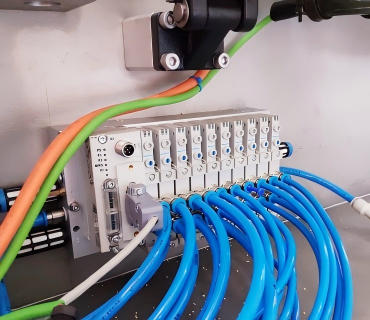
A Solenoid Valve Island (or simply “Valve Island”) with integrated I/O (Input/Output) and communication is a game-changer in industrial automation. It moves away from the “hard-wired” era (where every sensor and valve needed a separate wire back to the PLC) to a “networked” era.
Here are the key advantages of using a solenoid valve island with integrated I/O and communication capabilities:
1. Drastic Reduction in Cabling & Wiring (Cost & Time Savings)
This is the most significant advantage. Instead of running individual wires from the PLC to each valve and sensor:
- Single Cable Connection: You use one fieldbus cable (e.g., PROFINET, EtherNet/IP, EtherCAT, IO-Link) to connect the entire valve island to the control system.
- Elimination of Control Cabinets: In many modern setups, the valve island can be installed directly on the machine (decentralized control), completely eliminating the need for large, expensive control cabinets filled with relays and terminals.
- Reduced Labor: Wiring is often the most time-consuming and error-prone part of installation. This system reduces installation time by up to 80%.
2. Simplified Commissioning & Diagnostics
- Faster Startup: With standardized configuration files (GSDML, EDS), the PLC can automatically recognize the valve island setup, reducing programming errors.
- Remote Diagnostics: Instead of sending a technician to the machine with a multimeter, you can monitor the health of the system from the control room. The valve island can report:
- Coil Burnout: Detecting if a solenoid wire is broken or shorted.
- Short Circuit Protection: Automatically shutting down a channel to prevent damage.
- Sensor Verification: Checking if sensors connected to the I/O module are functioning correctly.
- LED Indicators: Physical LEDs on the valve island make local troubleshooting quick and easy.
3. Centralized Control & Flexibility
- Decentralized Installation: The valve island can be mounted directly on the pneumatic manifold, right next to the cylinders it controls. This brings the “control panel” to the machine, reducing hose length and pressure drop.
- Modularity: You can easily add or remove valves and I/O points as your machine requirements change, without rewiring the entire system. You can mix and match digital inputs, digital outputs, and analog modules.
- Parameterization: You can change settings (like output timing or pressure thresholds) remotely via software, rather than physically adjusting a knob on the machine.
4. Improved Reliability & Reduced Downtime
- Fewer Connection Points: Every wire connection is a potential point of failure (vibration, dust, corrosion). By reducing the number of wires, you significantly increase system reliability.
- Predictive Maintenance: Advanced valve islands can monitor the cycle count of valves or the current consumption of coils. This allows you to replace a valve before it fails, preventing unplanned downtime.
- IP65/IP67 Rating: These modules are typically housed in rugged enclosures, making them resistant to dust, water, and harsh industrial environments (oil, coolant) that would damage traditional relay panels.
5. Space Savings
- Compact Design: Modern valve islands (like the CPX or VTUX series) are incredibly compact. They save valuable space on the DIN rail inside the control cabinet or on the machine frame itself.
Summary of Advantages
| Feature | Benefit |
|---|---|
| Integrated Bus Communication | Replaces 100s of wires with 1 cable; Reduces hardware costs |
| Diagnostics | Identifies “coil burnout” or “short circuits” instantly; Reduces troubleshooting time |
| Modular I/O | Combines valve control and sensor input in one block; Flexible configuration |
| Decentralized Architecture | Eliminates control cabinets; Reduces hose/pipe length |
| Remote Parameterization | Allows settings changes via software without touching the hardware |
In essence, a solenoid valve island with integrated I/O and communication transforms your pneumatic system from a “dumb” collection of wires into an intelligent, networked node that talks directly to your PLC and MES system.