

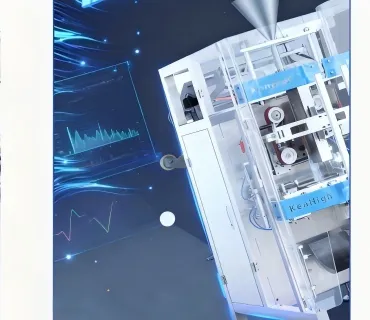
The primary advantage of a Continuous Motion Packing Machine over an Intermittent Motion one lies in its inherent ability to achieve higher speeds, greater efficiency, and superior mechanical stability.
Since the machine never stops moving, it eliminates the wear and tear caused by constant starting and stopping. Here is a detailed comparison of the advantages:
1. Speed and Output
- No Downtime: In an intermittent machine, time is lost every cycle when the mechanism stops (dwell time) to perform an action (like sealing or filling) and then has to re-accelerate. A continuous machine performs actions (sealing, cutting, filling) while the product is moving, allowing for much higher production rates.
- Higher Throughput: Continuous motion machines can often achieve speeds that are simply impossible for intermittent machines due to the physical limitations of accelerating and decelerating mass.
2. Mechanical Longevity & Stability
- Reduced Wear and Tear: Intermittent motion subjects the machine to constant inertial stress. Starting and stopping heavy components (like sealing jaws) creates vibration and shock, leading to faster wear of parts like clutches, brakes, and mechanical linkages. Continuous motion runs smoothly, resulting in lower maintenance costs and longer machine life.
- Gentler Handling: The smooth flow reduces the risk of jostling or knocking over products, which can happen when a conveyor jerks to a stop in an intermittent system.
3. Product Quality & Consistency
- Consistent Sealing/Processing: Because the process (e.g., heat sealing, coding) is applied to a moving target, modern continuous machines use synchronized servo drives to ensure perfect registration. This often results in more consistent seal quality compared to intermittent machines where spring tension or air pressure fluctuations can affect the seal force.
- Less Product Deformation: For delicate products, the smooth handling of continuous motion prevents the “sloshing” or shifting that can occur when a conveyor slams to a halt.
4. Energy Efficiency
- Lower Energy Peaks: Intermittent machines require high bursts of energy to accelerate heavy loads repeatedly. A continuous machine runs at a steady state, requiring less peak power and resulting in lower overall energy consumption.
📊 Quick Comparison: Continuous vs. Intermittent
| Feature | Continuous Motion Machine | Intermittent Motion Machine |
|---|---|---|
| Movement | Constant flow (Like a car on a highway) | Stop-and-go (Like a car at traffic lights) |
| Speed | Very High (No dwell time) | Lower/Moderate (Limited by inertia) |
| Mechanical Stress | Low (Steady state) | High (Vibration & shock from starting/stopping) |
| Best Use Case | High-volume, mass production | Lower volume, heavier/irregular products, R&D |
💡 When to Choose Which?
Choose Intermittent Motion if you have a low-to-medium budget, need to handle very heavy items that are hard to move dynamically, or require the machine to stop so an operator can manually inspect or place items.
Choose Continuous Motion if you are running a high-volume production line (e.g., food packaging, pharmaceuticals, consumer goods) where speed, efficiency, and low long-term maintenance are critical.