

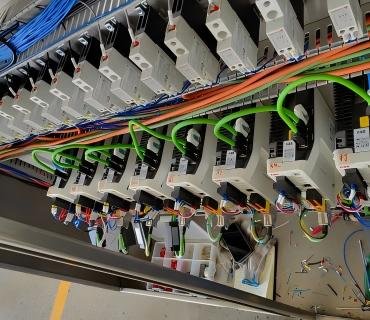
The core difference between a Full Servo Control Packing Machine and an Air Cylinder (Pneumatic) Activated Packing Machine lies in their “nervous system” and “muscles.” The servo system uses electricity and software for precise, flexible movement, while the pneumatic system relies on compressed air and mechanical valves for simpler, brute-force action.
Here is a detailed breakdown of the differences across various aspects:
1. Control & Precision
- Full Servo Machine: Offers extremely high precision. Servo motors can be controlled down to fractions of a millimeter. This allows for accurate positioning, speed control, and adjustable stroke length without changing hardware. It is ideal for tasks requiring exact alignment, such as sealing or cutting specific patterns on film.
- Air Cylinder Machine: Has limited precision. It relies on mechanical limit switches or simple sensors to determine position. Air is compressible, which can cause slight variations in movement (springiness), making it difficult to achieve high-accuracy positioning or fine speed adjustments.
2. Flexibility & Changeover
- Full Servo Machine: Highly flexible. If you change your product size or packaging film, you typically just select a new program on the touch screen. The servo motors will automatically adjust their行程 (stroke) and speed. This is crucial for handling multiple SKUs.
- Air Cylinder Machine: Inflexible / Rigid. The movement distance is often fixed by the length of the cylinder. Changing product sizes usually requires physically replacing parts, adjusting mechanical stops, or changing molds, which takes time and labor.
3. Speed & Efficiency
- Full Servo Machine: Generally faster and smoother. Servo motors have a high response rate, allowing for rapid acceleration and deceleration. They can also optimize motion paths to reduce cycle time.
- Air Cylinder Machine: Slower response. The speed is limited by the flow rate of air and the physical inertia of the cylinder. The impact at the end of the stroke also limits how fast the machine can run without causing damage or noise.
4. Energy Consumption & Cost
- Full Servo Machine: Energy efficient. It only consumes electricity when moving. Although the initial machine cost is higher, the long-term electricity and maintenance costs are usually lower.
- Air Cylinder Machine: Energy inefficient. It requires a continuous supply of compressed air, which is expensive to produce (air compressors consume a lot of electricity). There are also energy losses due to air leaks in the piping and fittings.
5. Maintenance & Environment
- Full Servo Machine: Low maintenance, clean, and quiet. It is an electric system with few wearing parts. It produces no oil mist or exhaust noise, making it suitable for clean room environments.
- Air Cylinder Machine: Higher maintenance, noisy, and messy. It requires regular maintenance of the air source (draining water, oiling). Air leaks can cause noise pollution, and oil mist from the pneumatic system can contaminate the production environment.
📊 Quick Comparison Table
| Feature | Full Servo Control Machine | Air Cylinder (Pneumatic) Machine |
|---|---|---|
| Power Source | Electricity (Servo Motors) | Compressed Air |
| Precision | High (Micron-level accuracy) | Low (Mechanical limits) |
| Flexibility | High (Change via software) | Low (Change via hardware) |
| Energy Use | Low (Only when active) | High (Constant air compression) |
| Noise Level | Low | High (Exhaust noise) |
| Maintenance | Low (Lubrication-free) | High (Air filter, leaks, oil) |
| Initial Cost | Higher | Lower |
| Best For | High-speed, multi-size, high-precision packaging | Simple, low-cost, rugged tasks |
💡 Summary
Choose an Air Cylinder Machine if your budget is tight, the task is very simple (e.g., just pushing a box), or the environment is extremely harsh where electronics might fail (though modern servo systems are quite rugged too).
Choose a Full Servo Machine if you need high speed, high precision, frequent product changeovers, and a clean environment. It is the standard for modern, high-end packaging lines.